
How to Write a Social Story for Your Child: A Step-by-Step Guide
How to write a social story your child really understands: one situation, sentences that describe rather than lecture, pictures, and when to read it.
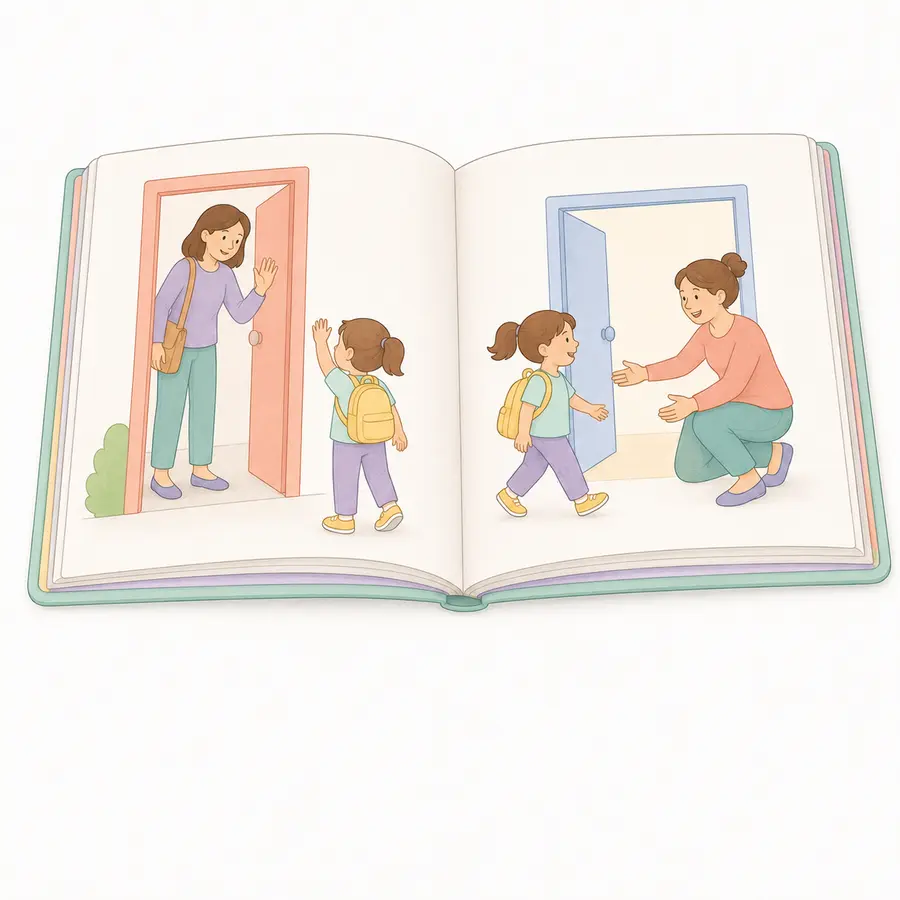
Children feel safer when they know what is going to happen. That is the whole idea behind a social story: a short, illustrated story that describes one situation for a child – a doctor's visit, the first day of preschool, guests at home – what happens, how people feel, and what the child can do. Social stories were first developed for autistic children, but they help any child who struggles with change, waiting, or new situations.
Step 1: Choose one situation
A good story is about one focused, concrete situation. Not "how to behave nicely", but "what happens when Grandma visits" or "what to do when I lose a game". Start with a situation that keeps coming back and keeps being hard – that is where a story helps fastest.
Step 2: See the situation through your child's eyes
Before writing, ask: what does my child see, hear and feel in this situation? What scares or confuses them? A child who cries at the barber may not be afraid of the haircut at all, but of the clipper's noise or the hair on their neck. Once you know what is really hard, you know what to write.
Step 3: Mostly describing sentences, a few guiding ones
Most sentences should describe: what happens, who is there, and how people feel. Only a few should suggest what to do. A good rule of thumb: at least two describing sentences for every guiding sentence.
- Describing: "At the barber there is a machine that buzzes."
- Describing a feeling: "Sometimes the noise feels too loud."
- Guiding: "I can ask to wear my headphones."
Write in the first person ("I"), in the present tense, and in positive language. Instead of "No shouting", write "I can use a quiet voice". Leave room for change with words like "usually" and "sometimes", so the story stays true when something is different.
Step 4: One sentence per page, with a picture
For young children, one idea per page works best, with a clear picture and one or two sentences. The picture should show exactly what the text says, with nothing distracting. In the site's social story builder you can choose a ready story, put your child's character in it, and print it.
Step 5: Read it together at a calm time
Read the story before the situation – not during it, and never right after a meltdown. The best time is a calm moment: at bedtime, or on the morning of the day it will happen. Read it several days in a row and let your child turn the pages. Afterwards, read it again and talk about how it went.
When to ask for help
If certain situations are hard again and again, affect your child's or your family's daily life, or come with strong meltdowns, talk with an occupational therapist or another professional who knows your child. A social story is a great tool, and it works best as part of a plan made for your child.