
Signs of Fine Motor Difficulties in Children: What to Look For
Which signs suggest fine motor difficulties: pencil grasp, cutting, buttons and self-feeding. What to try at home and when to see an occupational therapist.
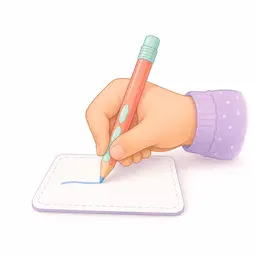
Fine motor skills are the ability to use the small muscles of the hands and fingers: holding a pencil, cutting, doing up a button, twisting a lid and eating with a fork. Children develop at different paces, so one hard skill is not a reason to worry. What to look for is a pattern: difficulty that shows up in several areas, or that gets in the way of your child's daily life.
Signs worth noticing
- Holding the pencil in a closed fist after age 4½–5, or switching hands all the time.
- Drawing and writing with very hard pressure (the pencil breaks, the paper tears) or very light pressure (the line is barely visible).
- Difficulty cutting in preschool: the scissors open and close without cutting, or the helper hand does not hold the paper.
- Avoiding puzzles, building bricks, threading or coloring, and always preferring only active play.
- Difficulty dressing and eating compared with peers: buttons, zippers, using a fork and spoon.
- A hand that tires quickly, or complaints that writing hurts.
Why does it happen?
Sometimes it is simply little practice: a child who plays mostly on screens or outdoors has not trained their hands yet. Sometimes it is about shoulder and hand strength, the feeling in the fingers, coordination between the two hands, or motor planning. Fine motor skills rest on a stable base: a child who finds it hard to sit steadily or keep a strong shoulder will also struggle with a pencil.
What you can do at home
The best way to strengthen the hands is through play, without turning it into homework. A few ideas from the site:
- Moving pom-poms with tweezers – strengthens the pincer grasp between thumb and finger.
- Clothespins by color – squeezing a clothespin strengthens the fingers and teaches how much force to use.
- A play-dough campfire – rolling, kneading and squashing warm up the hand before writing.
- Working on a vertical surface – drawing on paper taped to a wall or window strengthens the shoulder and straightens the wrist.
When to ask for an evaluation
If several signs appear together, if the difficulty does not improve with practice, or if your child starts avoiding and saying "I can't draw", ask an occupational therapist for an evaluation. An early evaluation helps you understand what is behind the difficulty and build a plan that fits your child. In the activity library you can filter activities by age and skill.